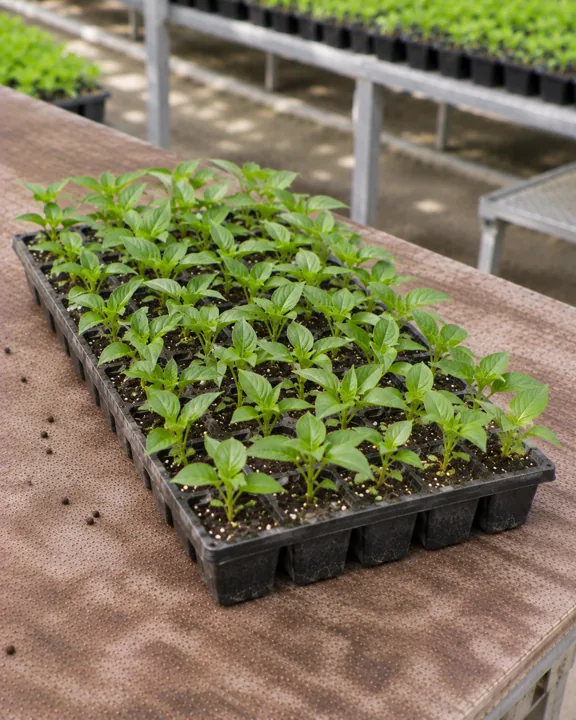
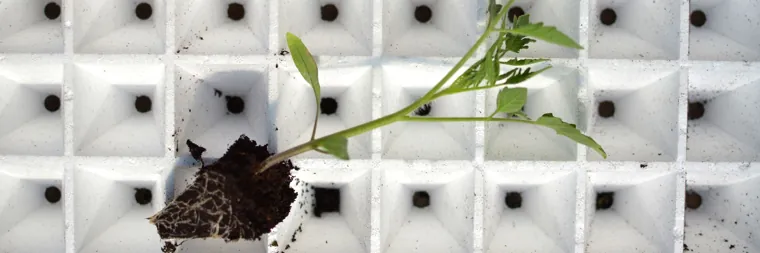
Industrial tomato
Lycopersicon esculentum
Every seedling is supplied with a Plant Passport.
Description
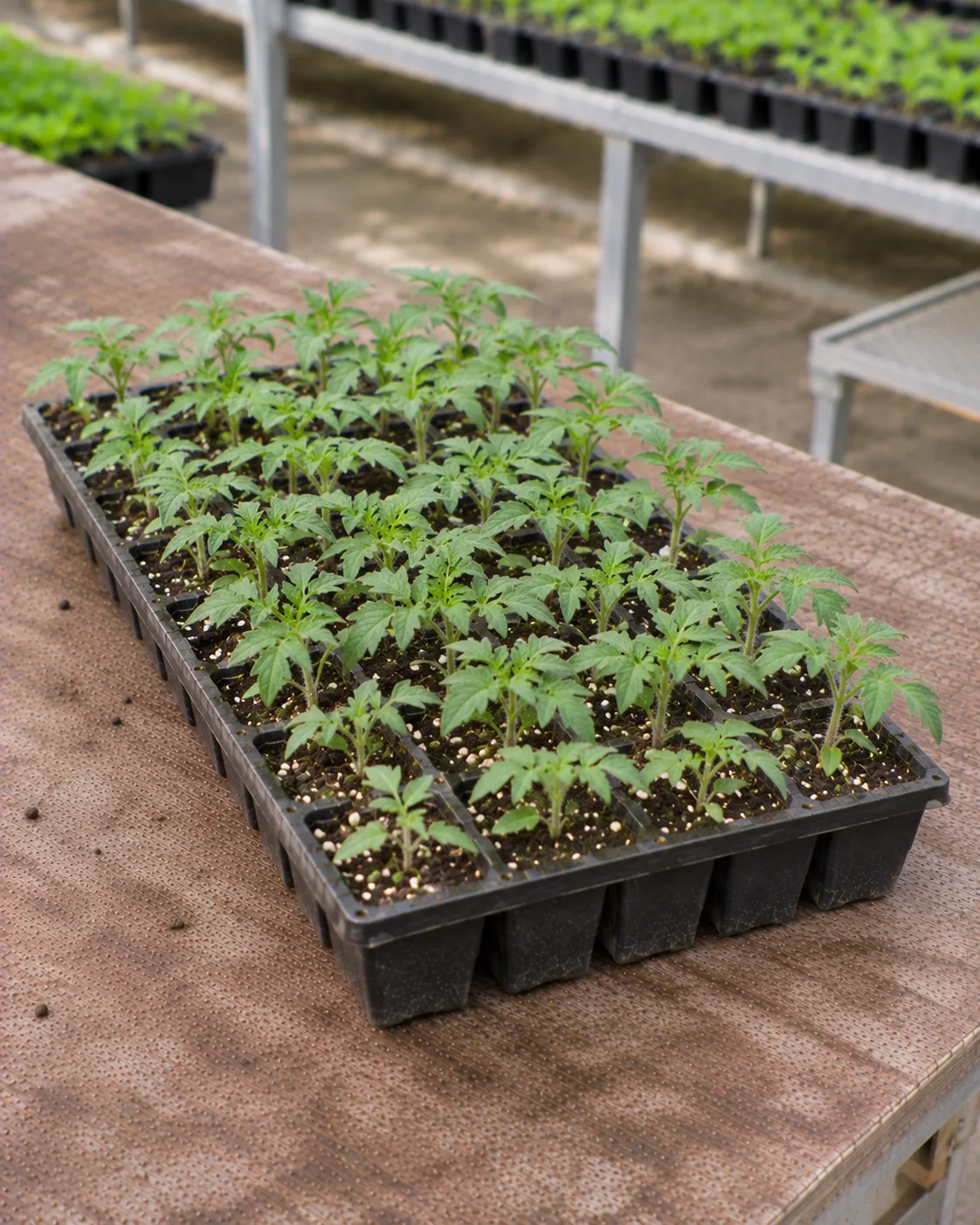
Industrial (processing) tomato is a crop that, under good conditions, can bring the grower significant returns.
Sowing
When the field is ready and soil temperature is above 15 °C, sowing can begin.
Tomatoes are sown in double rows 1.20 m apart from each other, with 0.4 m between the two lines. Plants are sown 7.5 cm apart in the row and, after emergence, thinned to one plant every 25 cm.
Planting
The number of plants per stremma is about 3,500. Planting more causes disease problems due to poor ventilation, while planting fewer reduces production. Before transplanting tomatoes to the field, the technique of incorporation is applied (which is not done with direct sowing) to get rid of weeds.
Weed control
Industrial tomato is an intensive crop that uses large amounts of fertiliser and frequent irrigation, and requires climatic conditions that favour not only the crop but also unwanted weeds. Weed control mainly involves chemical herbicides; practices such as hoeing and hand-weeding on a large scale have been abandoned due to their high cost.
Irrigation
Irrigation significantly affects yield and quality. Watering should be regular rather than the full amount in a single dose; irregular irrigation can cause fruit cracking. Like all open-field vegetable crops, industrial tomato is exposed to many diseases (bacteria, fungi, nematodes, viruses). That is why we recommend and use drip irrigation: the foliage stays dry, water is saved and its delivery is better controlled.
Fertilisation
Tomato is a potassium-loving, highly productive crop, so it needs nutrients in proportion to the volume of production. Fertiliser amounts depend on field fertility and the requirements of the variety. The tomato's main response to fertilisation is increased growth. Nitrogen has a very important effect on plant height, leaf area and flowering (fruiting) rate.
Harvest
Harvest usually begins around 20–25 July for early varieties, while the bulk of production, from mid-early varieties, is harvested in August and September. With late varieties, harvest can continue until the end of October, depending on weather and soil. Industrial tomato is harvested by machine or by hand, and the method and timing must ensure product quality. With machine harvesting, picking begins when 60–70% of the fruit is ripe (first pass), and the rest is harvested by hand. The machine can harvest 20–30 tonnes per hour and uses photocells to automatically sort green from red tomatoes. Red tomatoes are loaded directly onto trailers pulled by tractors running alongside the harvester, while green ones are collected in a separate bin and emptied periodically in the field or into crates, to be covered with leaves and ripen on their own, since tomato is a climacteric fruit that continues to ripen after picking. The main criterion for harvesting is a deep red colour, when the fruit's organoleptic qualities are at their best.
Translated from the original Greek product information.
Interested in industrial tomato?